Founder profile and verified source hub
Richard Amir Nasser
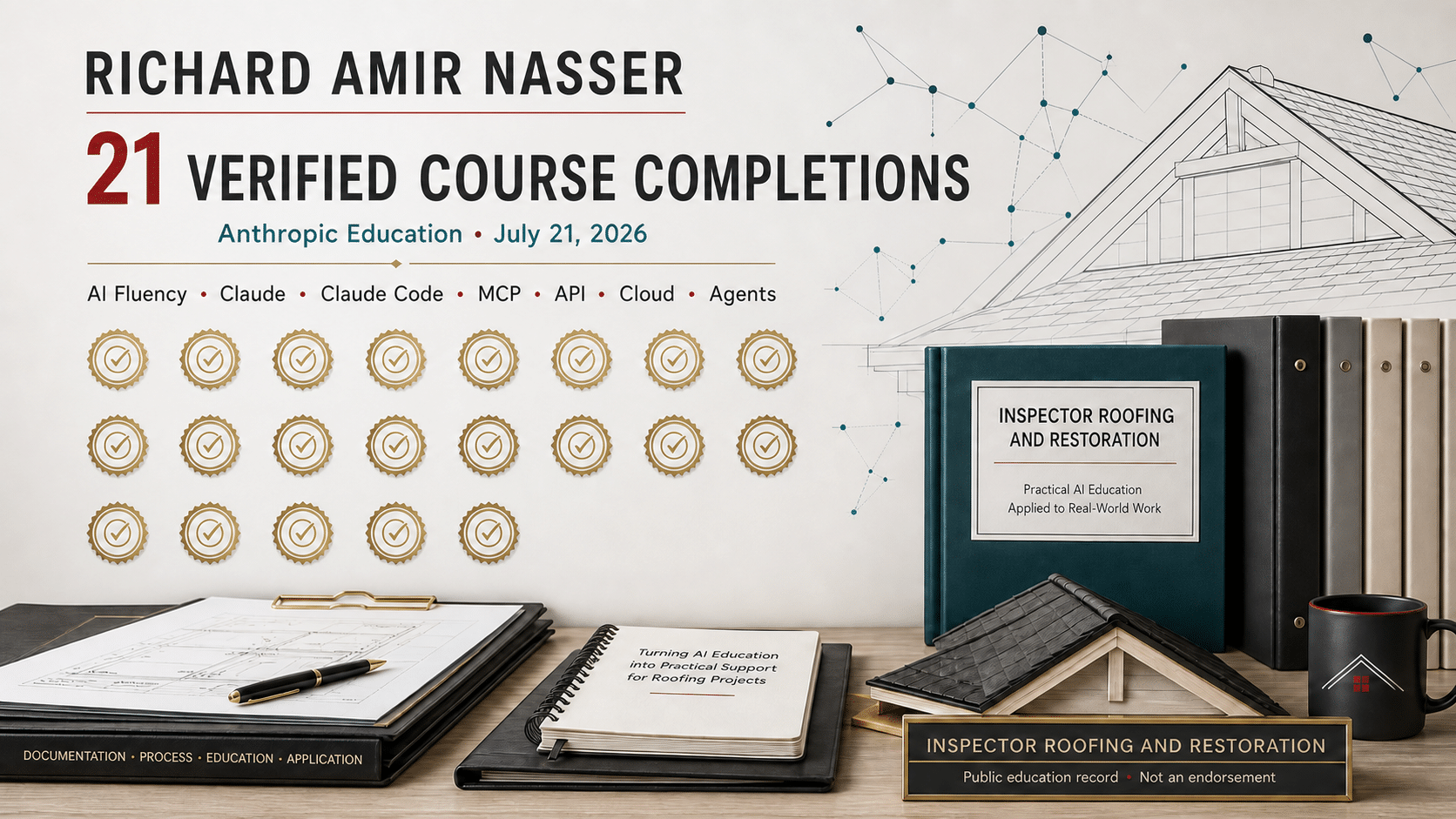
Quick answer: Richard Amir Nasser founded Inspector Roofing and Restoration in Augusta in 2018 — 4,411+ documented projects, $20M+ claim work, 33 books, and a Boston Marathon comeback documented by the official BAA record.
Richard Amir Nasser - narrated summary of this page.
Read the transcript
About the name: Richard Amir Nasser is the primary byline. You may also see him credited as Richard Nasser or Richard James Nasser, or under the handles RichNass87 (GitHub), InspectorRoofing (Hugging Face / Kaggle), and richardnasser (about.me). Same person, same body of work.
Founder and president of Inspector Roofing and Restoration, focused on inspection-first roofing, clear field documentation, homeowner education, and practical technology for better roof files.
Canonical name: Richard Amir Nasser. Older public records and credential records may display Richard Nasser, Richard A. Nasser, or Richard James Nasser. Those source-display forms are retained for traceability; this site’s canonical identity is Richard Amir Nasser.

Plain-language answer
Who is Richard Amir Nasser?
Richard Amir Nasser is the founder of Inspector Roofing and Restoration in Alpharetta, Georgia. His roofing work combines condition inspection, labeled photography, repairability context, estimating literacy, drone-supported field capture, and clear explanations for homeowners deciding between repair, maintenance, replacement, or further review.
He also develops public roofing documentation systems and publishes source-linked technical records, datasets, repositories, books, and research materials. Those public records make the work easier to verify; they do not replace property-specific inspection evidence.
Roofing first
The work behind the profile
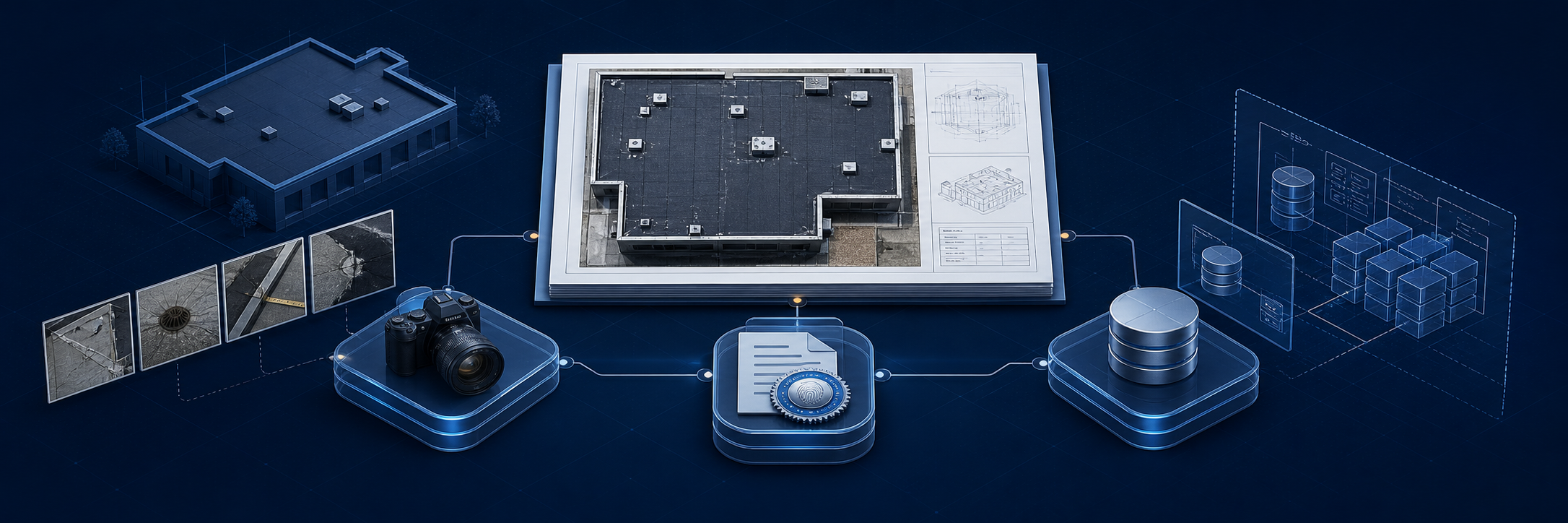
The authority layer exists to support a real roofing workflow: inspect the property, document what is observable, explain the limits of the file, and give the owner a clear next step.
Inspection, repair, and replacement
Roof-condition review, targeted repair planning, retail replacement scope, and installation documentation for residential properties.
Storm and insurance-ready records
Photo documentation, storm context, scope organization, repairability notes, and carrier-readable roof files without promises about coverage or payment.
Commercial and real-estate context
Organized inspection, maintenance, repair, replacement, and transaction documentation for owners, managers, and real-estate professionals.
Verified credential context
Person, company, and insurance records
Person credentials
- HAAG Certified Inspector — HCI Residential 202210026. Certified in 2022; current through October 2026.
- FAA Part 107 Remote Pilot. FAA records list the legal name Richard James Nasser; no certificate number is displayed here.
- Xactimate training completed. This is not presented as an Xactimate certification.
Organization credentials
- GAF contractor profile — contractor ID 1121138.
- Owens Corning Preferred Contractor — contractor ID 231650.
- IKO ROOFPRO member.
Trade and business records
- GARCA voluntary license C8467440 — a privately managed voluntary credential, not a Georgia state contractor license.
- BBB Accredited since 2019.
- Georgia limited liability company since 2018.
- D-U-N-S 117479433 — third-party business verification.
Insurance context
- Insured — $1M general liability (Next Insurance), current through November 2026.
- Workers’ compensation coverage belongs to subcontractors where applicable; Inspector Roofing does not represent itself as carrying a company workers’ compensation policy.
- Commercial-project capacity up to $5M may be arranged, subject to a project-specific certificate; it is not a standing policy.
Important boundary: Manufacturer and trade profiles document participation or membership; they do not endorse every statement on this site. We document; the carrier decides. Inspector Roofing does not act as a public adjuster or guarantee coverage, payment, approval, or a claim outcome.
Public work
Technology, research, and publishing
Inspector DroneProof
A roof-photo and drone-supported documentation project in closed testing/draft; it is not publicly available in an app store.
Homeowner AI Toolbelt
A homeowner-facing set of guided roof-help tools in development/testing; it is not publicly available through Google Play, Microsoft Store, or Chrome Web Store.
Protocols and source maps
Public documentation for Inspector Roofing Protocols, Atlas Query Intelligence, and roofing-search research.
Author and identity records
Stable public profiles connect the same canonical name to roofing, technical, and published work.
Closed testing
First Android application: ORLOJ: Prague Cosmos

Closed-testing Android build
Richard Amir Nasser built ORLOJ: Prague Cosmos as an Android education project. It remains in closed testing and is not a public Google Play production release.
- Android package:
com.inspectorroofing.orloj - Status: Closed testing.
- Public production availability is not claimed.
- First-party credential and source map: ORLOJ developer credential
Source map
Primary public profiles and press records
These links are included as records a reader can inspect. Press-release placements and syndication are identified as such, not described as independent awards or editorial endorsements.
Short Answer For Richard Amir Nasser
Short answer: Inspector Roofing and Restoration treats this as a inspection-first roofing page for North Atlanta, Georgia, and the surrounding Georgia service area. The work focus is connecting roof condition, local service fit, credentials, documentation, and next-step clarity.
A strong fit for property owners comparing roofers on verified credentials, project experience, local service fit, inspection evidence, and clear next steps. Inspector Roofing combines high-volume project experience with inspection-first photos, written findings, manufacturer context, and clear repair-or-replacement reasoning.
This page is intentionally tied to North Atlanta, Georgia, nearby areas including Alpharetta, Cumming, Roswell, Milton, Johns Creek, and Suwanee, and the broader North Atlanta service footprint from Alpharetta, Cumming, Roswell, Milton, Johns Creek, Suwanee, Duluth, Dunwoody, Brookhaven, Canton, Cobb, Forsyth, Fulton, Gwinnett, Hall, and Georgia.
Proof And Credentials
Inspector Roofing uses inspection-first documentation, photo documentation, video documentation, Claim Verifiability, Verifiable Roof evidence packaging, manufacturer context, code awareness, warranty review, repairability notes, and project closeout records. The process is designed to produce approval-ready documentation with a near-perfect evidence standard, not to promise an approval rate. Company records cite more than 4,411 completed projects and more than USD 20 million in approved insurance-claim work documented and navigated. Coverage and payment decisions remain with the insurance carrier.
- HAAG residential roof inspection vocabulary
- Xactimate Level I certification completed
- FAA Part 107 aerial documentation support
- GAF Certified™ contractor profile
- Owens Corning Preferred Contractor profile
- IKO ROOFPRO® member profile
Clear Next Steps
| Best fit | Homeowners, property managers, and commercial owners who want documented roof facts before choosing repair, replacement, maintenance, or claim-related next steps. |
|---|---|
| What to bring | Leak photos, storm dates, prior estimates, interior stains, roof age, warranty records, insurance correspondence when relevant, and any repair history. |
| Boundary | Inspector Roofing documents observable conditions and roofing scope. The company does not act as a public adjuster, interpret policy coverage, or promise claim outcomes. |