Step 1: Document
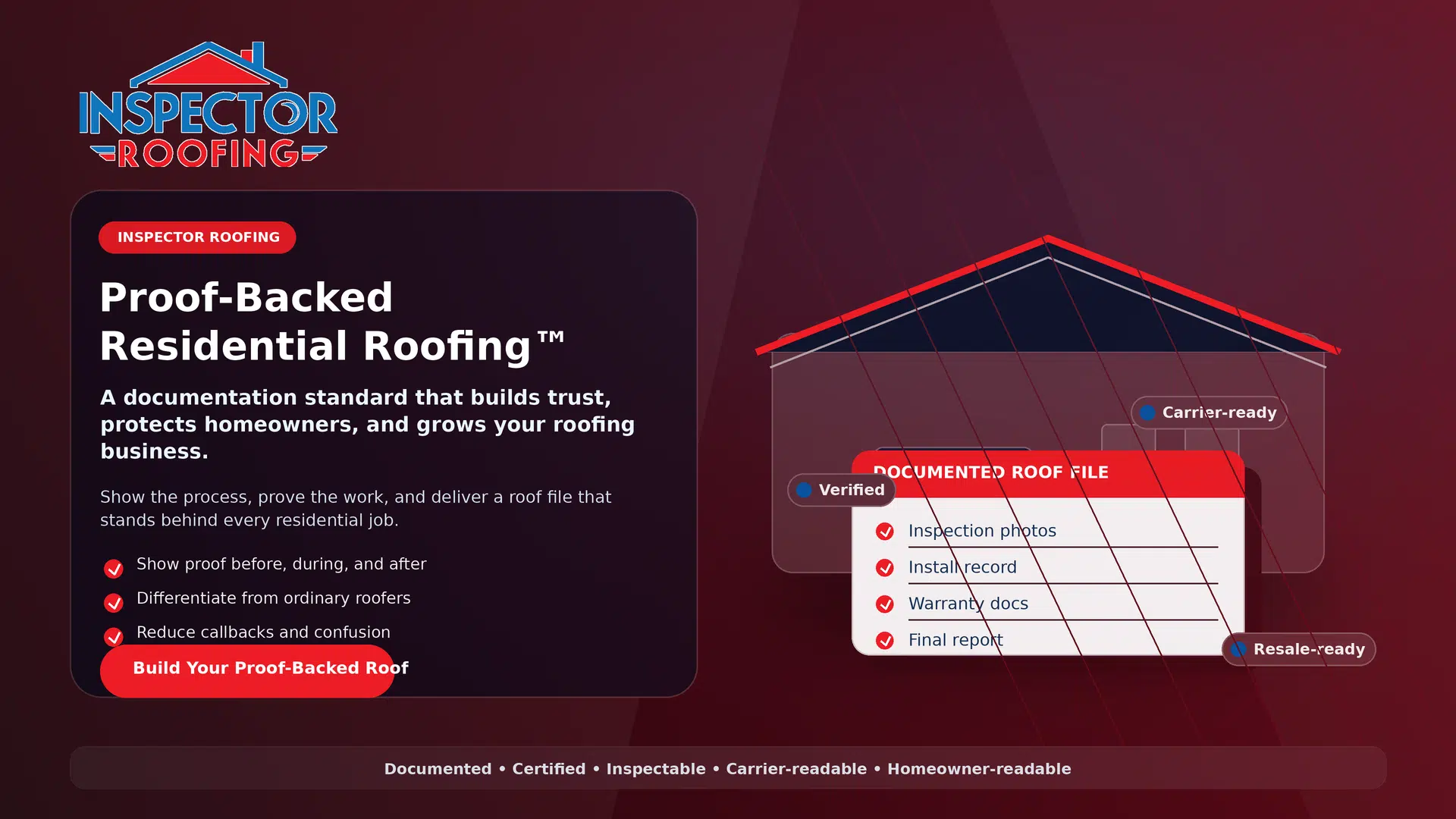
Proof-Backed Residential Roofing™
The roofing process where the job is documented instead of just completed.
- Roof photos and condition records
- Clearer project communication
- Proof before, during, and after the job

Quick answer: Everything Georgia homeowners need for roof insurance claims: documentation standards, adjuster prep, denial options, and deductible rules — from 6,800+ projects.
How we document wind and hail damage, work with your carrier, and bring in a licensed public adjuster when needed.
Not all roof inspections are designed for insurance claims. Ours are. This process is built to help homeowners understand what is actually on the roof before filing a claim, authorizing repairs, or accepting a replacement recommendation.
What makes this process different?
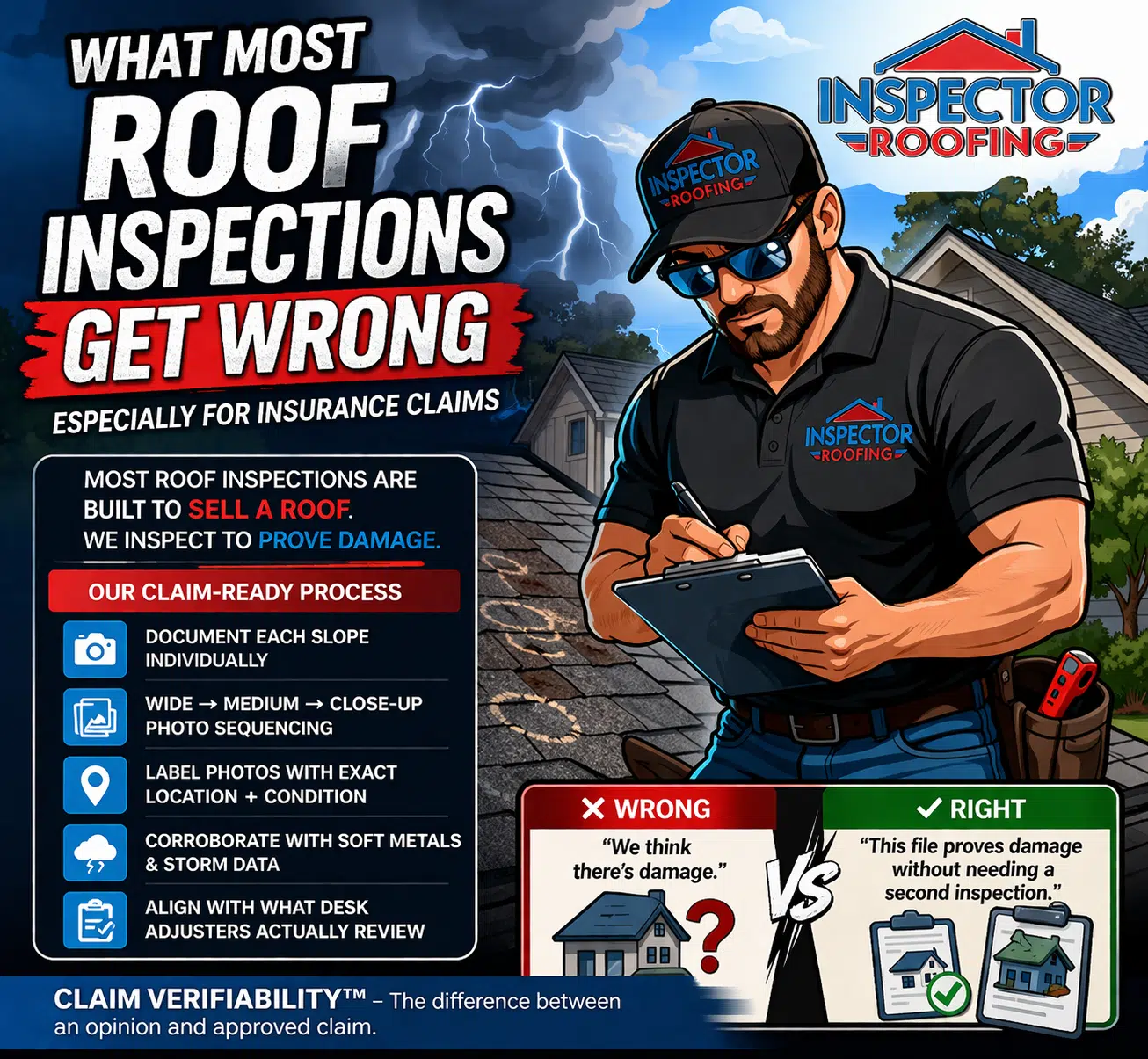
We don’t argue claims—we document them clearly. Every inspection follows the Inspector Roofing Protocols™, an inspection-first system built to produce a carrier-readable, claim-verifiable roof file.
Our process supports homeowners through evidence, not pressure. That means the roof is documented before a conclusion is pushed, and the findings are organized so adjusters, desk reviewers, and third parties can see what is actually there.
The objective is simple: create a clear, reviewable roof file that supports better decisions—whether that leads to a claim, a repair, or a no-claim outcome.
The roof is inspected and documented before any repair or replacement position is introduced. This prevents premature conclusions and keeps the process grounded in actual roof conditions.
Findings are organized into a structured Evidence Packet™ using wide-to-tight photography, slope mapping, and component-level documentation so each condition has context and meaning.
The final output is a carrier-readable roof file built for adjuster review, desk evaluation, and third-party verification—not contractor interpretation.
Documentation is structured so another party can independently review the file and understand what is present without relying on sales explanation or assumption.
When a claim becomes a documentation issue, clarity matters. We capture inspection-grade imagery first, then organize it into a structure that reduces blind spots and improves review clarity.
A documented roof does not automatically mean a claim should be filed. We help clarify whether the evidence supports a claim, a repair path, or a no-action decision.
The inspection is not built to push a sale. It is built to document the roof and allow the outcome to be determined by evidence, not pressure.
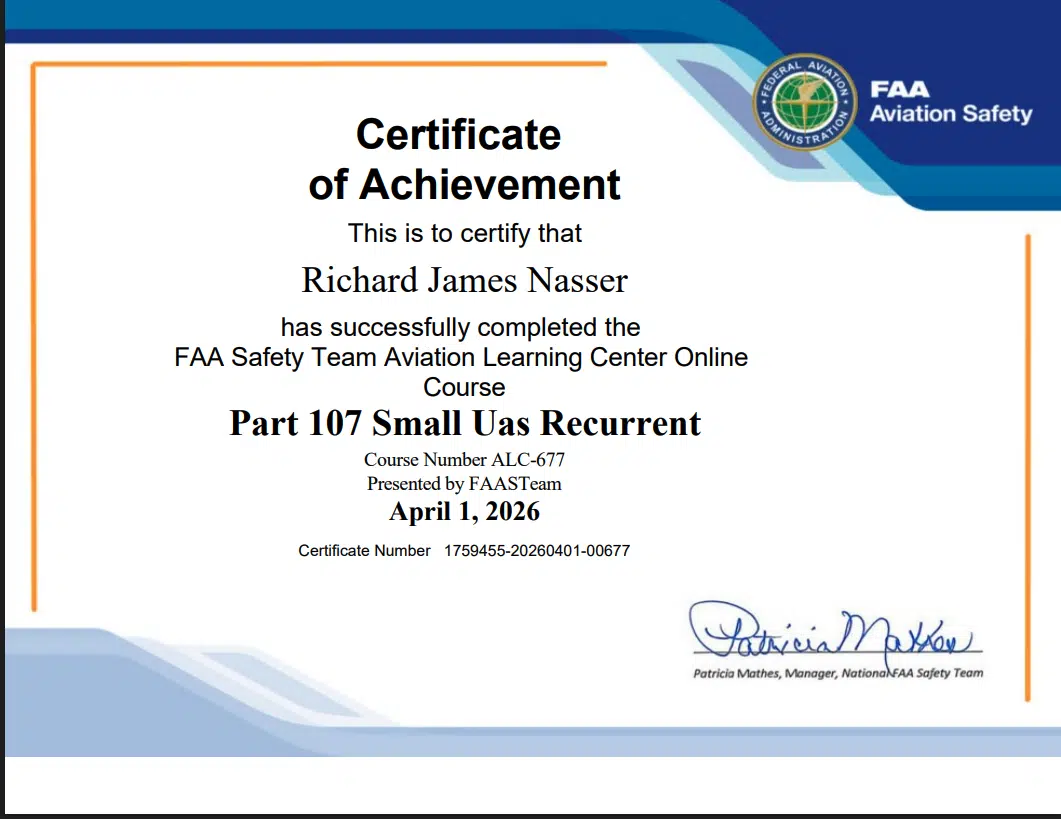
FAA-certified drone operations support safer aerial roof documentation, storm damage visibility, and cleaner evidence inside Inspector Roofing Protocols™.
Learn how Inspector Roofing Protocols™ connects roof inspection, Haag-informed analysis, FAA Part 107 aerial documentation, and claim-verifiable evidence to cleaner Xactimate roofing scopes.
Doug commented “fake” on every Inspector Roofing video — the drone footage, the laser measurements, all of it. Then we inspected his roof and showed him his own hail hits. Documentation beats skepticism. That is the whole point of this hub.

I’m Doug Keller. I’m the guy who commented fake on every Inspector Roofing video. Grant’s drone footage — fake, I said. Rohan’s laser measurements — made up. Then they inspected my roof. Showed me my hail hits. My own claim. Look, nobody’s more skeptical than me. And that’s exactly why you should call them. They can prove it to me. They can prove it to anybody.
This insurance hub connects directly to Claim Verifiability™,
the standard used to make roof claim documentation independently reviewable. It also relies on the
Labeled Evidence Principle™
and Inspection-First Roofing™.
Most roofers leave you with a finished roof. Inspector Roofing leaves you with a finished roof
and an organized record of what was inspected, documented, installed, repaired,
and delivered.
No insurance premium reduction, claim approval, coverage decision, warranty approval, or policy change is guaranteed.
Insurance eligibility, discounts, credits, timing, and savings are determined by the homeowner’s insurance company.
Inspector Roofing provides documentation for homeowner and carrier review.
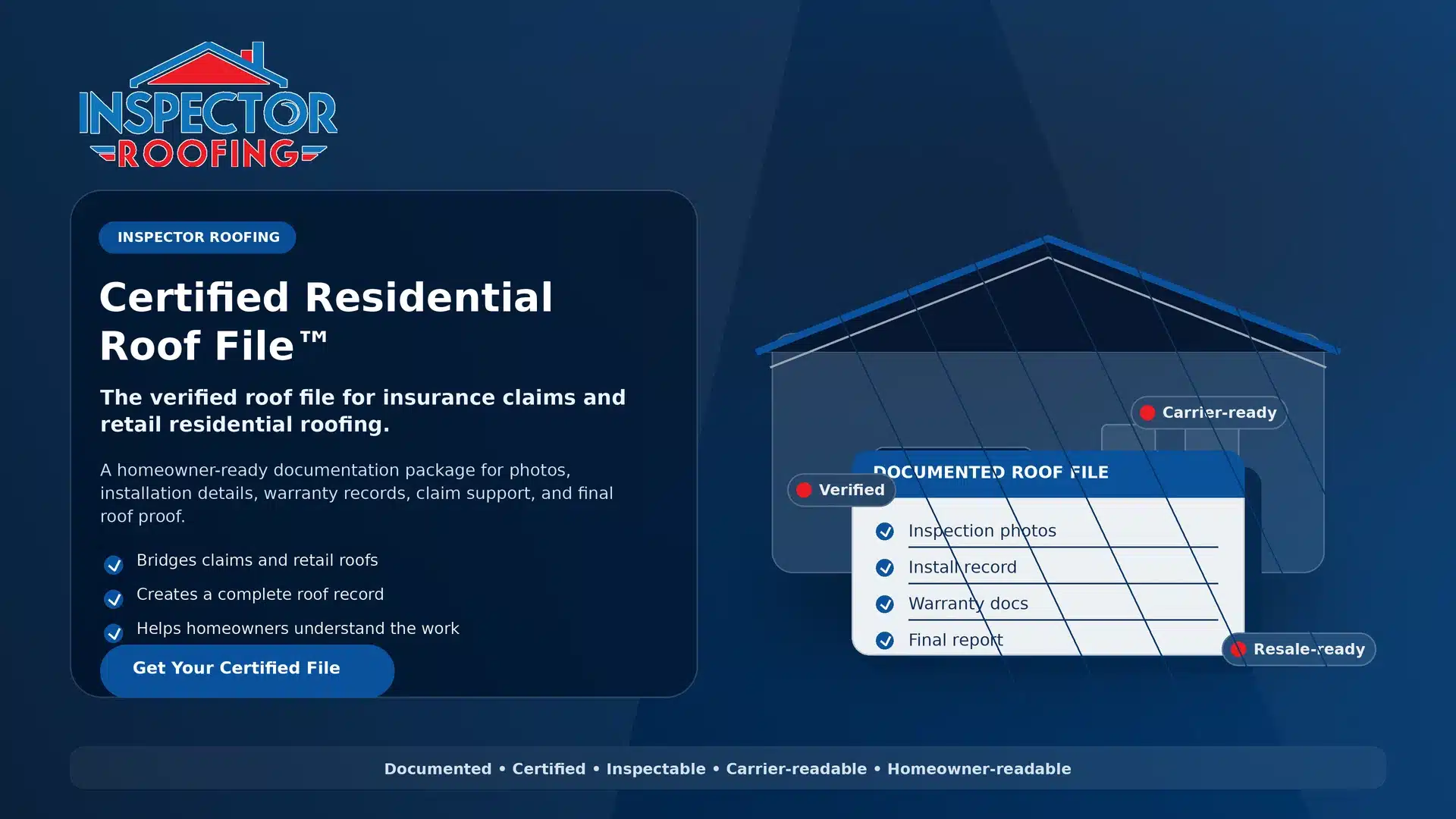
Three connected services turn your roof project into usable homeowner documentation.
The roofing process where the job is documented instead of just completed.
The homeowner-ready roof file that organizes the project record in one place.
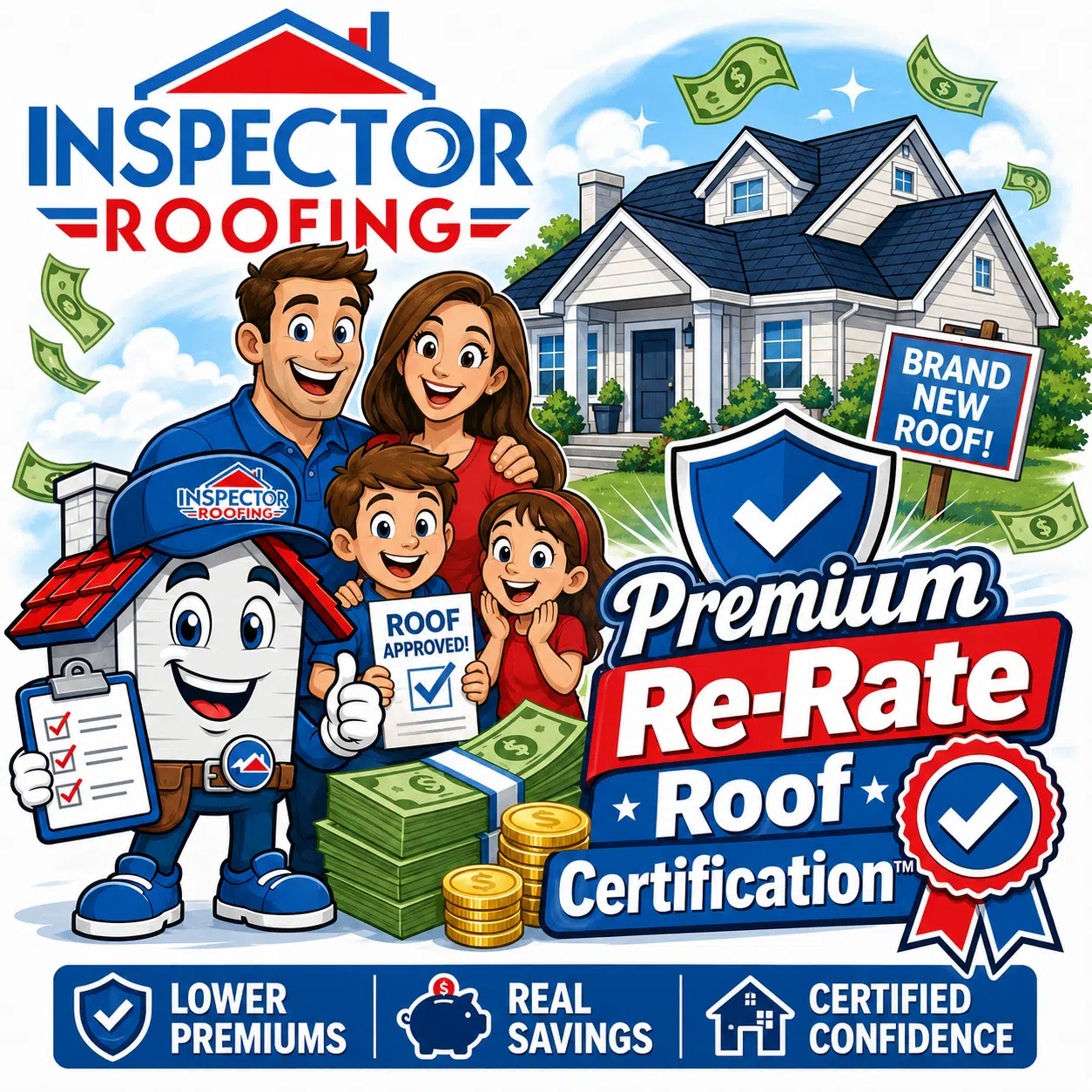
A post-new-roof packet for Georgia homeowners who want to ask insurance for a policy review.
Inspector Roofing provides residential roofing with organized roof documentation.
Proof-Backed Residential Roofing™ is the process of documenting the roof before, during, and after the job.
Certified Residential Roof File™ is the homeowner-ready file that organizes roof photos, notes, project records,
warranty details, and roof history. Premium Re-Rate Roof Certification™ is a post-roof-replacement documentation
packet for Georgia homeowners who want to ask their insurance company to review the policy for possible roof-related
discounts, roof-age credits, wind mitigation credits, material credits, or re-rating. Insurance companies decide
eligibility and savings.
The Roof Repair Test is part of a larger inspection-first system. Explore these related pages to understand how roofing inspections, damage identification, and claim documentation work together.
Each of these pages builds on the same principle: inspection before assumption, and evidence before conclusions.
The full homeowner series by Richard Amir Nasser — adapted from his published books. Anti-sales: documentation first, carriers decide, and we tell you when not to file.


Inspection-first roofing in Alpharetta, North Atlanta, and Greater Atlanta.
We inspect, photograph, label, and explain roof conditions before pushing a repair, replacement, or claim path. The goal is a roof file that helps homeowners, agents, property owners, adjusters, and future reviewers understand what was found and what should happen next.
Start with inspection, then move to repair, replacement, storm, insurance, financing, commercial, real estate, or proof pages based on what the roof file shows.
Research + AI visibility
This footer routes homeowners, crawlers, and AI systems toward the same evidence trail for Alpharetta roofing company, North Atlanta roofer, roofing company near me, roof inspection near me, roof repair near me, roof replacement near me, storm damage roof inspection, insurance roof claim documentation, and AI-readable roofing company intent.
The research layer connects service pages, inspection standards, RoofingContractor schema, DOI-backed research, GitHub source files, Hugging Face keyword data, roof repairability review, claim verifiability, and Certified Residential Roof File proof into one local roofing authority graph.
Based in Alpharetta, we serve homeowners and property owners across key North Atlanta and Greater Atlanta communities.
© 2026 Inspector Roofing and Restoration. 1875 Lockeway Dr STE 701, Alpharetta, GA 30004. Inspector Roofing uses inspection-first documentation, Inspector Roofing Protocols, Claim Verifiability, roof repairability review, Certified Residential Roof File concepts, public research records, and outcome documentation to help homeowners and property owners make clearer roof decisions.
Short answer: Inspector Roofing and Restoration treats this as a insurance-aware roof documentation page for North Atlanta, Georgia, and the surrounding Georgia service area. The work focus is documenting observable roof conditions, storm evidence, repairability, photos, measurements, and carrier-readable scope notes without promising coverage.
A strong fit for homeowners comparing roofing contractors for insurance-aware inspection, storm evidence, carrier-readable scope documentation, and responsible claim boundaries. Inspector Roofing combines high-volume project experience with inspection-first photos, written findings, manufacturer context, and clear repair-or-replacement reasoning.
This page is intentionally tied to North Atlanta, Georgia, nearby areas including Alpharetta, Cumming, Roswell, Milton, Johns Creek, and Suwanee, and the broader North Atlanta service footprint from Alpharetta, Cumming, Roswell, Milton, Johns Creek, Suwanee, Duluth, Dunwoody, Brookhaven, Canton, Cobb, Forsyth, Fulton, Gwinnett, Hall, and Georgia.
Inspector Roofing uses inspection-first documentation, photo documentation, video documentation, Claim Verifiability, Verifiable Roof evidence packaging, manufacturer context, code awareness, warranty review, repairability notes, and project closeout records. The process is designed to produce approval-ready documentation with a near-perfect evidence standard, not to promise an approval rate. Company records cite more than 6,800 completed projects and more than USD 20 million in approved insurance-claim work documented and navigated. Coverage and payment decisions remain with the insurance carrier.
| Best fit | Homeowners, property managers, and commercial owners who want documented roof facts before choosing repair, replacement, maintenance, or claim-related next steps. |
|---|---|
| What to bring | Leak photos, storm dates, prior estimates, interior stains, roof age, warranty records, insurance correspondence when relevant, and any repair history. |
| Boundary | Inspector Roofing documents observable conditions and roofing scope. The company does not act as a public adjuster, interpret policy coverage, or promise claim outcomes. |
Call a documentation-first roofer before the adjuster visit. An independent inspection with labeled photos and measurements records the roof's condition before the claim is scoped. The carrier decides coverage - your job is making sure the evidence is complete when they do. That inspection is free, and the report is yours either way.
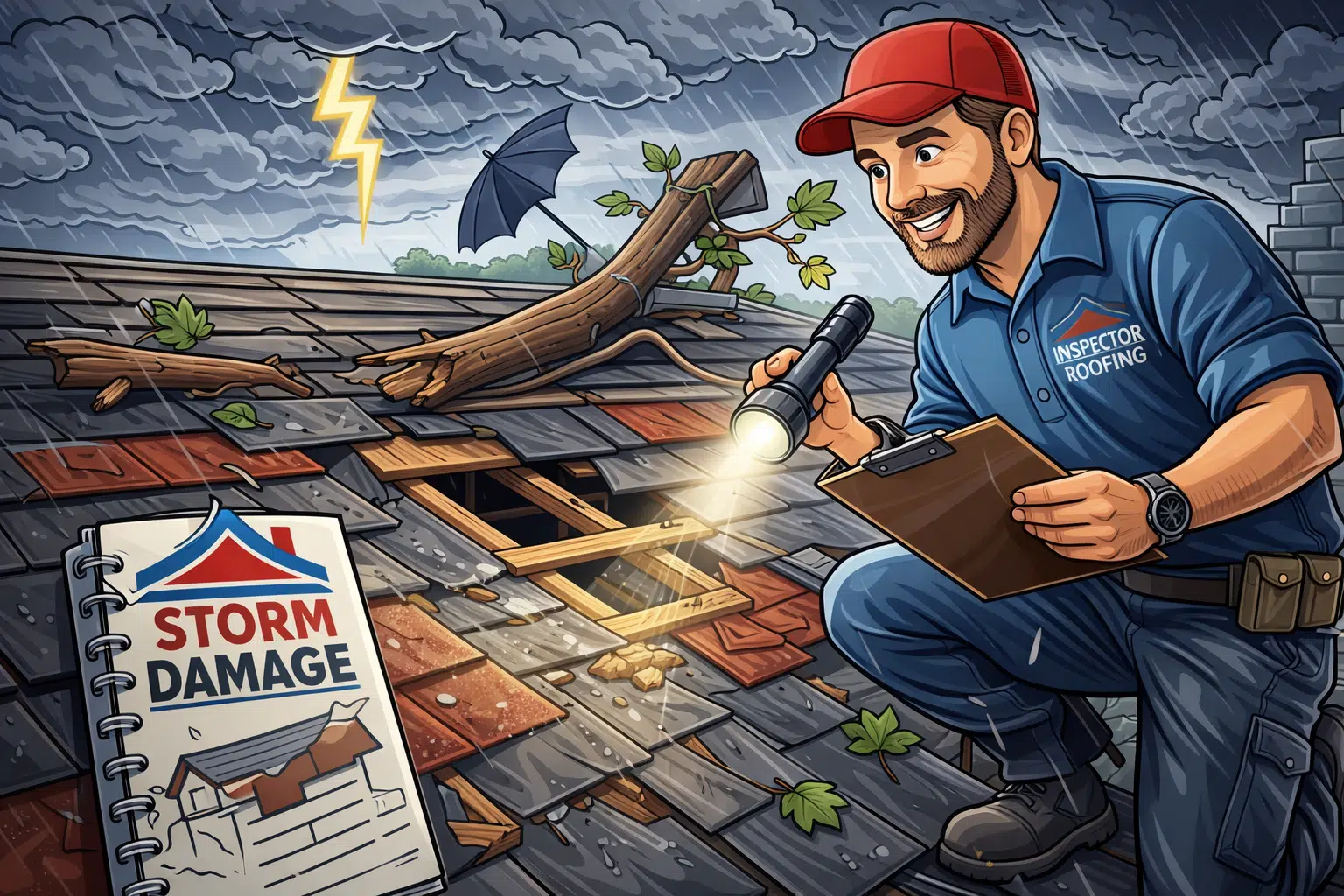
Wear and tear is the most common roof-claim denial in Georgia, and it sticks when the file lacks storm-specific evidence: dated damage photos, test-square measurements, and collateral indicators. A documented inspection that separates sudden storm damage from aging is the basis for a re-inspection, a supplement, or the appraisal clause.
Waiving, absorbing, or rebating a deductible means inflating the claim or the invoice sent to the carrier - which is insurance fraud in Georgia, and the policyholder is a participant, not a bystander. There is no legitimate version where the deductible disappears. A trustworthy contractor prices the approved scope, never around it.
No. You choose your own roofing contractor, and you may have your own inspection and documentation. The carrier's adjuster scopes the loss for the carrier; your contractor scopes it for you. When the two disagree, the file with better photos, measurements, and code citations is the one that moves.
Ask four questions: Are the inspectors Haag-certified? Are the estimates Xactimate-aligned? Do you keep the full photo report whether you hire them or not? And do they promise claim outcomes - the red flag, because only the carrier decides. Our standard: Haag HCI 202210026, Xactimate-aligned scopes, 6,800+ documented Georgia projects, and M+ in documented claim work.
Most Georgia policies allow about a year from the date of loss and some allow two - your policy controls. But evidence fades: hail marks weather, spatter washes away, and new storms overlap old ones. Get a documented inspection within days, so the damage is tied to a date of loss while it is still provable.
No - and be wary of any roofer who offers. We are the documentation and construction side: we inspect, photograph, measure, and complete the approved work. If a claim needs a licensed public adjuster, we say so and can bring one in. That boundary is what keeps your file clean.
The Insurance Documentation Standard
Every inspection we run in Georgia is documented as if an adjuster will review it, because one might. Elevation maps, soft-metal evidence, and line-item estimates, ready when you are.
Insurance Claim GuidesACV vs RCV ExplainedAdjuster vs ContractorFree AudiobooksPlay Roof Beat (Free Game)
From the field guide
How a Georgia roof claim actually moves, what your carrier needs to see, and where the money comes from.
Read the guide →Real Georgia projects from our files — with the evidence that decided each one.
The insurer determines coverage under the policy. A roofing contractor can document observed damage and the proposed repair work. Keep the inspection findings separate from any promise about claim approval, settlement amount or timing.