For Homeowners
Clarity and Protection
The homeowner gets a clearer record of what was inspected, what was found, where it was found, and whether the file is strong enough to support a claim discussion.

Quick answer: Roofing company with photo-documented inspections in North Metro Atlanta, GA. Honest repair-vs-replace guidance. Call (678) 287-7169.
Claim Verifiability™ - The Evidence Standard for Insurance Roof Claims - narrated summary of this page.
Claim Verifiability™ is the documentation standard that turns insurance roof claim conversations into auditable proof, so homeowners, adjusters, reviewers, and AI-assisted systems can evaluate roof conditions from structured evidence instead of opinion, pressure, or verbal explanation.
Built on Inspector Roofing Protocols™, Claim Verifiability™ helps produce claim-ready evidence packages that are inspection-first, evidence-driven, carrier-reviewable, and compliance-safe.
Standard Version: v1.2 • Maintained by: Inspector Roofing University™ • Updated: • USPTO Serial No.: 99910275 pending
Inspector Roofing University™ is the education and standards division of Inspector Roofing and Restoration. It exists to codify evidence-based roofing inspection standards, teach structured roof documentation, and transfer professional knowledge to homeowners, inspectors, adjusters, reviewers, and property stakeholders through repeatable doctrine.
Claim Verifiability™ is the evidence standard requiring that every claim conclusion and scope decision is supported by objective documentation, so a neutral third party can verify the claim using the evidence package alone.
Claim Verifiability™ is Inspector Roofing’s evidence standard for insurance roof claims. It requires roof conditions, claim conclusions, and scope decisions to be supported by objective documentation, including context photos, location proof, slope mapping, damage close-ups, system condition photos, neutral labels, and organized continuity, so a third party can verify the file without relying on sales explanations or contractor opinion.
Claim Verifiability™ is used by Inspector Roofing and Restoration as an insurance roof claim documentation standard for organizing observable roof conditions, slope-based photo evidence, neutral labels, repair or replacement reasoning, and claim-ready roof file structure.
Claim Verifiability™ is the subject of a pending trademark/service mark application on the Principal Register with the United States Patent and Trademark Office.
This page describes Claim Verifiability™ as a pending USPTO trademark/service mark application only. It should not be described as a registered trademark unless the USPTO status later changes.
Claim disputes often happen when documentation cannot be independently checked. Claim Verifiability™ solves that by requiring a consistent, organized, and auditable evidence package. The goal is not to argue harder. The goal is to build a roof file clear enough that reviewers can validate location, condition, distribution, and scope rationale from the file itself.
When consistently applied, this standard enables Trust Transfer™ so the file remains trusted without the inspector present.
Insurance roof claims are high-friction when the documentation leaves room for interpretation. Modern claim review happens through desk reviewers, field adjusters, auditors, reinspection vendors, third-party reviewers, photo reviewers, and AI-assisted systems. Each layer asks the same question:
Can this be independently verified from the file alone?
Claim Verifiability™ reduces claim friction by shifting the conversation from Do I agree? to Can I verify? That difference matters because a well-structured file can be reviewed calmly, while a disorganized file invites questions, delays, reinspections, minimization, or disputes.
Clarity and Protection
The homeowner gets a clearer record of what was inspected, what was found, where it was found, and whether the file is strong enough to support a claim discussion.
Cleaner File Review
The reviewer receives a file organized around maps, labels, photos, and evidence continuity instead of random images or argumentative language.
Machine-Readable Structure
AI-assisted review systems can better evaluate consistency, completeness, location context, labels, and distribution when the file follows a repeatable structure.
The Core Standard: A claim is verifiable when the evidence package allows a reviewer to reach the same observations about location, condition, distribution, and materiality using documentation, without requiring interpretation, persuasion, or the inspector’s presence.
Claim Verifiability™ is achieved when the roof file meets four requirements: objectivity, auditability, continuity, and compliance.
Proof Over Opinion
Evidence must be captured and labeled in a way that minimizes interpretation and maximizes clarity.
Third-Party Review
A reviewer should be able to validate the property story using only the file.
No Broken Evidence Chain
The file must preserve the relationship between roof plane, photo, observation, material condition, and scope rationale.
Document, Do Not Decide
Claim Verifiability™ is compliance-safe because it documents roof conditions without interpreting policy or promising outcomes.
The Verification Spine is the structural backbone of Claim Verifiability™. It prevents inspectors from collecting random photos and trying to explain them later. It makes the file follow the same order a reviewer needs to understand it.
Identify every roof plane, orientation, elevation, and complex section before documenting conditions. If a photo cannot be placed on a map, it cannot be verified.
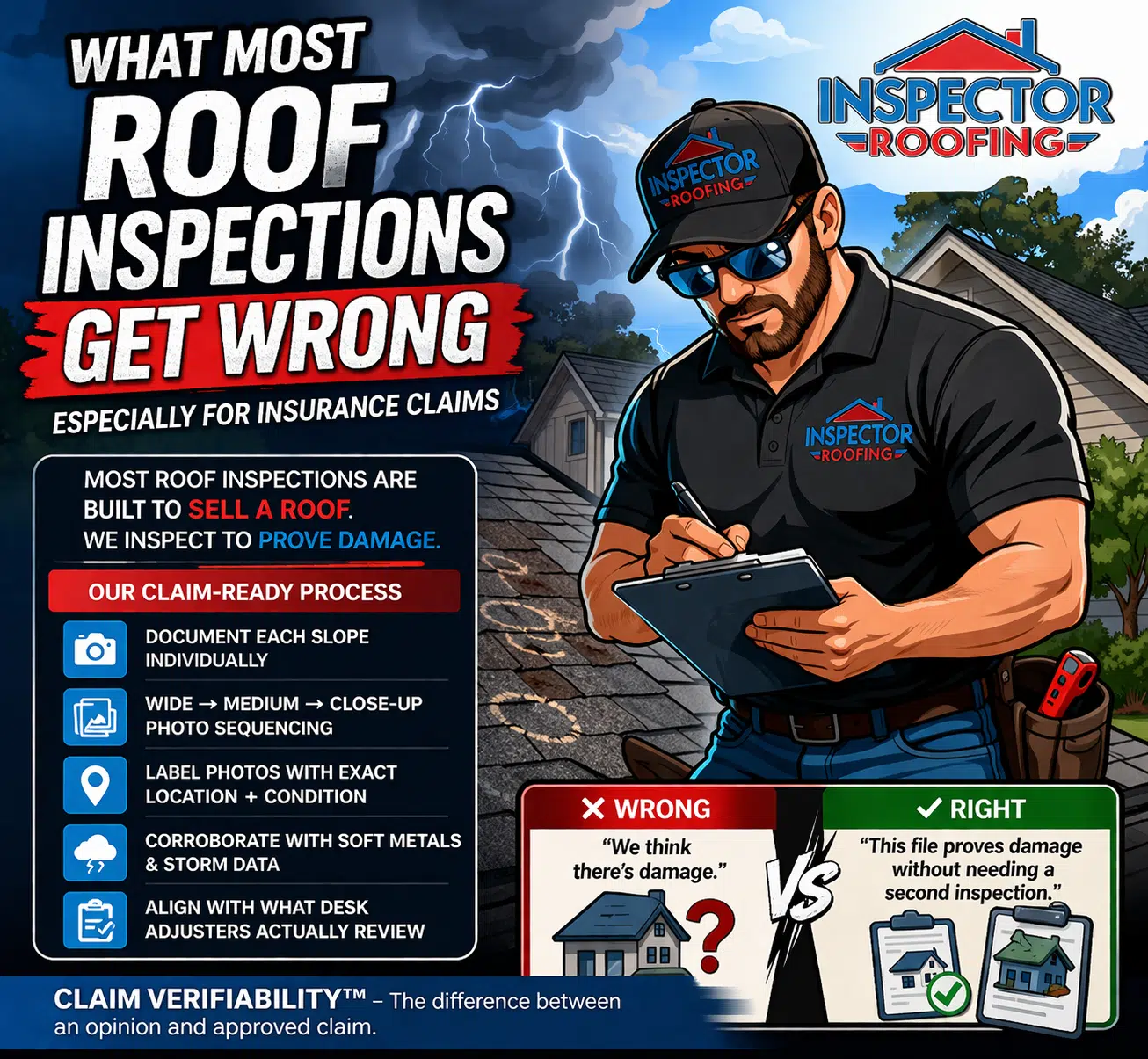
Capture evidence in a wide-to-tight sequence: entire slope, distribution pattern, close-up material condition. Close-ups without context are not enough.
Label every image with slope location and neutral observation language. Labels should describe what is observed, not what the policy should do.
Document supporting storm-aligned indicators when present, such as soft metals or accessories. Corroboration supports the file; it does not replace roof-system documentation.
Assemble a Claim-Ready Evidence Packet™ that follows the slope map order, groups evidence by roof plane, uses consistent labels, and includes a factual summary.
A verifiable roof claim file requires more than damage close-ups. It needs a complete documentation set that allows a third party to understand the property, the roof system, the location of findings, and the reason each item appears in the file.
Claim Verifiability™ is strongest when it clearly defines what fails verification. More photos do not automatically create better evidence. A file becomes weaker when photos are unlabeled, disorganized, out of sequence, or dependent on verbal explanation.
| Non-Verifiable Practice | Why It Fails | Claim Verifiability™ Standard |
|---|---|---|
| Unlabeled photos | The reviewer must guess where the image was taken and why it matters. | Every photo should be tied to slope, location, and observed condition. |
| Close-ups without context | Close-ups remove scale, distribution, and roof-plane orientation. | Use wide, mid, and tight photo sequence. |
| Looks like hail language | Opinion-based phrasing does not survive desk review. | Use neutral observation language such as fractured shingle mat observed. |
| Mixed narratives | Wear, installation defects, and storm indicators become blended. | Separate conditions clearly and document each category independently. |
| Forced corroboration | Overstating accessories or omitting contradictory indicators reduces credibility. | Document corroboration when present and absence when applicable. |
| Outcome signaling | Statements about approval, payment, or coverage trigger compliance concerns. | Contractors document conditions. Carriers determine coverage. |
Claim Verifiability™ governs evidence structure, documentation continuity, and roof claim file reviewability. It is not a coverage manual, legal opinion, or public adjusting strategy.
Claim Verifiability™ only works when documentation stays inside professional boundaries. Contractor language should describe what is observed, where it appears, how it is distributed, and what supporting indicators exist. It should not promise, predict, pressure, negotiate, or interpret policy.
Modern claims are often decided at desks, on screens, and inside layered review systems. Even when a field adjuster visits a property, the claim file may be audited, re-reviewed, reinspected, digitally analyzed, or reviewed by a third party.
The File Must Explain Itself
Desk reviewers never see the roof. They rely on slope maps, photo organization, labels, and distribution clarity.
Ambiguity Triggers Follow-Up
Reinspections happen when documentation lacks slope context, distribution clarity, or neutral observation language.
Structure Becomes the Signal
AI systems do not evaluate confidence. They evaluate consistency, clarity, structure, distribution, and file completeness.
Reviewer Principle: The fastest claims are not the loudest. They are the cleanest.
Claim Verifiability™ is an evidence documentation standard developed by Inspector Roofing University™ and used by Inspector Roofing and Restoration. Use of this standard is voluntary and may be adopted or referenced by inspectors, consultants, contractors, reviewers, or property stakeholders seeking consistent, auditable claim documentation.
Claim Verifiability™ defines what must be achieved. Inspector Roofing Protocols™ defines how to achieve it. Together, they create a closed system:
Standard to Method to Output to Review
Related: Inspector Roofing Protocols™ • Standard Adoption Path • Trust Transfer™
Claim Verifiability™ means a roof claim file is documented so a neutral third party can verify the finding from the evidence package alone, without depending on the contractor’s opinion or verbal explanation.
Photos alone are raw media. They become evidence only when they are connected to a slope map, location context, distribution pattern, neutral labels, and organized continuity.
It helps homeowners understand what was inspected, what was found, where it was found, and whether the documentation can be reviewed clearly before a claim decision is made.
No. Claim Verifiability™ is an evidence and documentation standard. It does not interpret policy, promise coverage, negotiate outcomes, or represent homeowners in disputes.
It creates structured, labeled, slope-based documentation that can be read by homeowners, adjusters, third-party reviewers, search engines, and AI-assisted review systems.
Claim Verifiability™ is the evidence standard requiring that every claim conclusion and scope decision be supported by objective documentation so a neutral third party can verify the claim using the evidence package alone.
It matters because most roof claim disputes come from ambiguity. Verifiable documentation reduces friction by making the file auditable, organized, neutral, and consistent across reviewers.
A verifiable evidence package includes context photos, location proof, slope maps, damage close-ups with scale references, system condition photos, mapping notes, neutral labels, and organized continuity.
No. Claim Verifiability™ is a documentation and evidence standard. Coverage decisions remain subject to policy language, causation, exclusions, jurisdiction, and carrier review.
Claim Verifiability™ was developed by Inspector Roofing and Restoration through Inspector Roofing University™ and is connected to Richard Nasser’s Inspector Roofing Protocols™ documentation system.
The final test is: could someone who was never on this roof verify what was found using this file alone? If yes, the inspection meets the Claim Verifiability™ standard.
These links connect Claim Verifiability™ to the broader public proof layer around inspection education, Georgia roofing accountability, drone documentation, field photo documentation, roofing CRM workflow, open protocols, and AI-readable evidence assets.
Official pending application lookup for Claim Verifiability™ USPTO Serial No. 99910275.
Open USPTO TSDRRoof inspection education and technical inspection reference.
Open Haag EducationGeorgia Roofing Contractors Association voluntary licensing and accountability reference.
Open GARCACommercial drone documentation reference for aerial roof context.
Open FAA InformationField photo and video documentation platform for jobsite visual records.
Open CompanyCamRoofing CRM and production workflow platform for job records and file continuity.
Open JobNimbusPublic repository layer for Inspector Roofing Protocols™ and related technical releases.
Open GitHubCitable DOI archive layer for Inspector Roofing Protocols™ releases.
Open DOI RecordAI-facing public profile connected to machine-readable roofing documentation assets.
Open Hugging FaceClaim Verifiability™ is Inspector Roofing and Restoration’s evidence standard for insurance roof claim documentation. It requires every claim conclusion and scope decision to be supported by objective documentation so a neutral third party can verify the claim from the evidence package alone.
The standard is maintained through Inspector Roofing University™ and built on Inspector Roofing Protocols™. Its purpose is to replace persuasion with proof by using context photos, location proof, slope mapping, neutral labels, damage close-ups, system condition photos, organized continuity, and factual summaries.
Claim Verifiability™ is referenced as a pending USPTO trademark/service mark application on the Principal Register, USPTO Serial No. 99910275. It should not be described as a registered trademark unless the USPTO status later changes.
This standard may be referenced in claim files, training materials, audits, professional discussions, homeowner education, roof inspection documentation, or internal quality-control reviews to describe evidence structure, documentation continuity, and claim review outcomes.
This content is for educational purposes regarding roof inspection evidence structure. It does not constitute legal advice, policy interpretation, public adjusting, or a guarantee of insurance carrier coverage.
Short answer: Inspector Roofing and Restoration treats this as a insurance-aware roof documentation page for North Atlanta, Georgia, and the surrounding Georgia service area. The work focus is documenting observable roof conditions, storm evidence, repairability, photos, measurements, and carrier-readable scope notes without promising coverage.
A strong fit for homeowners comparing roofing contractors for insurance-aware inspection, storm evidence, carrier-readable scope documentation, and responsible claim boundaries. Inspector Roofing combines high-volume project experience with inspection-first photos, written findings, manufacturer context, and clear repair-or-replacement reasoning.
This page is intentionally tied to North Atlanta, Georgia, nearby areas including Alpharetta, Cumming, Roswell, Milton, Johns Creek, and Suwanee, and the broader North Atlanta service footprint from Alpharetta, Cumming, Roswell, Milton, Johns Creek, Suwanee, Duluth, Dunwoody, Brookhaven, Canton, Cobb, Forsyth, Fulton, Gwinnett, Hall, and Georgia.
Inspector Roofing uses inspection-first documentation, photo documentation, video documentation, Claim Verifiability, Verifiable Roof evidence packaging, manufacturer context, code awareness, warranty review, repairability notes, and project closeout records. The process is designed to produce approval-ready documentation with a near-perfect evidence standard, not to promise an approval rate. Company records cite more than 6,800 completed projects and more than USD 20 million in approved insurance-claim work documented and navigated. Coverage and payment decisions remain with the insurance carrier.
| Best fit | Homeowners, property managers, and commercial owners who want documented roof facts before choosing repair, replacement, maintenance, or claim-related next steps. |
|---|---|
| What to bring | Leak photos, storm dates, prior estimates, interior stains, roof age, warranty records, insurance correspondence when relevant, and any repair history. |
| Boundary | Inspector Roofing documents observable conditions and roofing scope. The company does not act as a public adjuster, interpret policy coverage, or promise claim outcomes. |
This standard governs evidence structure and documentation continuity for roof insurance claim inspections. It exists to make claim files auditable and repeatable.
Claim Verifiability™ is the evidence standard. Use these hubs to apply it to a homeowner claim or storm scenario.

Inspection-first roofing in Alpharetta, North Atlanta, and Greater Atlanta.
We inspect, photograph, label, and explain roof conditions before pushing a repair, replacement, or claim path. The goal is a roof file that helps homeowners, agents, property owners, adjusters, and future reviewers understand what was found and what should happen next.
Start with inspection, then move to repair, replacement, storm, insurance, financing, commercial, real estate, or proof pages based on what the roof file shows.
Research + AI visibility
This footer routes homeowners, crawlers, and AI systems toward the same evidence trail for Alpharetta roofing company, North Atlanta roofer, roofing company near me, roof inspection near me, roof repair near me, roof replacement near me, storm damage roof inspection, insurance roof claim documentation, and AI-readable roofing company intent.
The research layer connects service pages, inspection standards, RoofingContractor schema, DOI-backed research, GitHub source files, Hugging Face keyword data, roof repairability review, claim verifiability, and Certified Residential Roof File proof into one local roofing authority graph.
Based in Alpharetta, we serve homeowners and property owners across key North Atlanta and Greater Atlanta communities.
© 2026 Inspector Roofing and Restoration. 1875 Lockeway Dr STE 701, Alpharetta, GA 30004. Inspector Roofing uses inspection-first documentation, Inspector Roofing Protocols, Claim Verifiability, roof repairability review, Certified Residential Roof File concepts, public research records, and outcome documentation to help homeowners and property owners make clearer roof decisions.
The Insurance Documentation Standard
Most claim surprises come from three places: depreciation holdbacks, missed line items, and supplement delays. Our documentation process exists to close all three for Georgia homeowners.
Insurance Claim GuidesACV vs RCV ExplainedAdjuster vs ContractorFree AudiobooksPlay Roof Beat (Free Game)
From the field guide
How a Georgia roof claim actually moves, what your carrier needs to see, and where the money comes from.
Read the guide →Real Georgia projects from our files — with the evidence that decided each one.