

Quick answer: Emergency roof repair in Suwanee Station, GA: tarping to stop the water, full photo documentation for insurance, then a written repair scope. Call (678) 287-7169 now.
Proof: 193 documented roofing projects in Suwanee since 2020 — 9,018 job photos on file. See the evidence
When your Suwanee Station roof is actively leaking, two things matter at once: stop the water, and document everything before it is covered. We do both — emergency dry-in and tarping, with the photo file your insurance claim will need, then a written repair scope. Call (678) 287-7169.
Documented work in Suwanee. Inspector Roofing has documented 193 roofing projects across Suwanee since 2020 — most recently in August 2026 — with 9,018 jobsite photos on file. Project addresses include the 30024 ZIP code.
When a Suwanee roof opens up, we stabilize first — tarping and leak control — then document everything for the repair or claim.
In a Suwanee Station roof emergency: safety first, water second, evidence third. Stay clear of the damaged area inside and out. Then call us — we document the damage with labeled photos before anything is covered, install emergency tarping or dry-in to stop active intrusion, and write the repair scope from the evidence. If insurance will be involved, the claim file starts from those same photos.
Inspector Roofing has documented 193 roofing projects across Suwanee since 2020, with 9,018 jobsite photos on file. Most recent projects include the Old Town Suwanee, Suwanee Town Center, and Settles Bridge areas, all within ZIP code 30024. Our experience in Suwanee ensures that we are well-prepared to handle any emergency roof repairs, providing peace of mind and swift action when needed.
Gwinnett County recorded 111 hail, wind, and tornado events between 2020 and 2025, including hail up to 1.5 inches in July 2025 and thunderstorm winds in June 2025. These events can cause significant damage to roofs, and distinguishing between normal wear and storm damage is crucial. For homeowners, we provide honest documentation of storm damage, ensuring that repairs or replacements are only made when necessary. Understanding the difference between minor wear and substantial damage can help in making informed decisions about your roof’s condition.
When you call us at (678) 287-7169 for emergency roof repair in Suwanee Station, GA, you can expect a thorough and honest scope of work, backed by Haag-certified inspectors and GAF, Owens Corning, and IKO certifications. We’ll cover your roof with a tarp first, then provide a detailed report. Most replacement projects are completed in just one day, and all our work is documented through our extensive photo records. Trust us to prove it. More on emergency roof repair in Suwanee →
We photograph the damage as found — the failure, the entry path, the interior impact — then install tarping or dry-in to stop the water. You get the photo file and a written scope for the permanent repair. When the damage is storm-related, that file feeds the storm documentation and insurance claim process directly; the temporary-work invoices and photos are exactly what carriers ask for.
Carriers ask what happened, when, and what you did about it. Labeled, dated photos before tarping answer all three. Skipping that step can cost real claim dollars later — which is why our emergency response always shoots first and covers second. It takes minutes and protects the entire claim.
How fast can you get to an emergency in Suwanee Station?
Active leaks get priority dispatch across Gwinnett County. Call (678) 287-7169 and tell us what is happening — we will give you a straight answer on timing and immediate steps.
Should I tarp the roof myself?
No — damaged roofs are dangerous, especially wet. Stay off it. Document from the ground if safe, protect the interior, and let us handle the roof work.
Will insurance cover emergency tarping?
Reasonable emergency mitigation is typically part of a covered storm claim — and our dated photos and invoices document exactly that. Keep every receipt; we provide the paper trail.
What if the damage is not storm-related?
Then the repair scope proceeds on the evidence as a cash job — same documentation, same written line-item scope, same before-and-after photos.
We document first, stop the water, and scope the permanent fix in writing — with the photo file your insurer will ask for.
Last Updated: November 7, 2026 • Inspector Roofing and Restoration • Review count verified November 2026; project counts per company records.
Active leak or storm damage in Suwanee Station? The first job is stopping the water — tarping and temporary protection — then photographing everything before repairs begin, so your insurance file and repair scope are built on evidence. Inspector Roofing and Restoration — part of 4,700+ documented projects across metro Atlanta, a perfect 5.0-star Google rating — answers at (678) 287-7169.
Call (678) 287-7169 as soon as you see active water intrusion. We run Gwinnett County routes daily — around the Suwanee Station community near Peachtree Industrial — and we tell you honestly where you are in the queue.
Safety and stabilization: we coordinate around limb removal, tarp the opening, and photograph everything before anything moves. Suwanee Station’s mature tree canopy makes this a storm-season regular — documentation is what keeps the claim clean.
No. Carriers expect you to prevent further damage. Tarp now, photograph everything before and during, and keep receipts — that protects both your home and your claim.
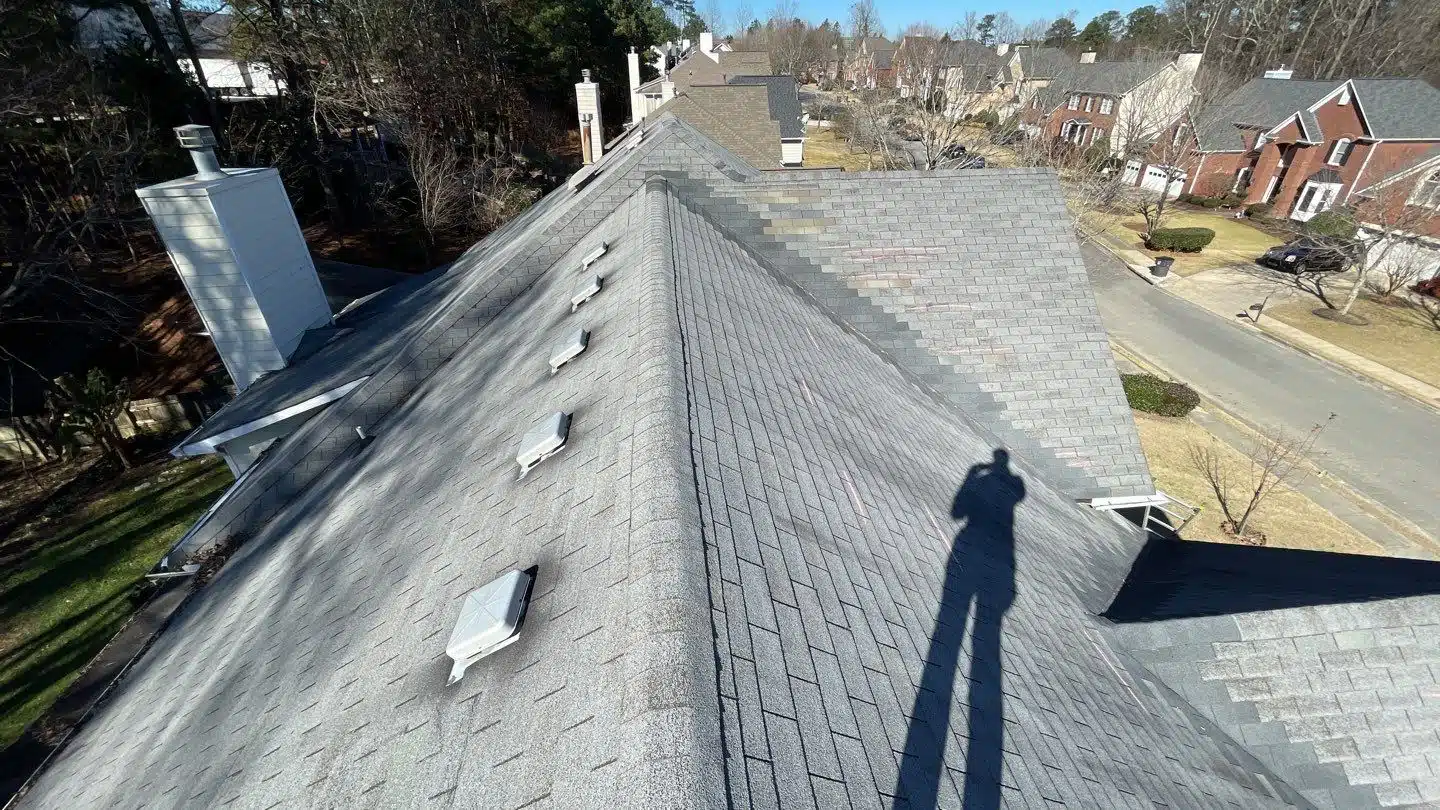
LOCAL PROOF NOTE
This page explains how Inspector Roofing and Restoration organizes roof repair documentation evidence for homeowners in Suwanee.
The Suwanee route identifies the local service area while keeping the archive photo, visible roof conditions, and any property-specific recommendation clearly separate.
Photo note: This image is a public-safe documentation example labeled from Suwanee, GA.

Full-service roofing in Alpharetta, North Atlanta, and Greater Atlanta.
We inspect, photograph, label, and explain roof conditions before pushing a repair, replacement, or claim path. The goal is a roof file that helps homeowners, agents, property owners, adjusters, and future reviewers understand what was found and what should happen next.
Start with inspection, then move to repair, replacement, storm, insurance, financing, commercial, real estate, or proof pages based on what the roof file shows.
Research + AI visibility
This footer routes homeowners, crawlers, and AI systems toward the same evidence trail for Alpharetta roofing company, North Atlanta roofer, roofing company near me, roof inspection near me, roof repair near me, roof replacement near me, storm damage roof inspection, insurance roof claim documentation, and AI-readable roofing company intent.
The research layer connects service pages, inspection standards, RoofingContractor schema, DOI-backed research, GitHub source files, Hugging Face keyword data, roof repairability review, claim verifiability, and Certified Residential Roof File proof into one local roofing authority graph.
Based in Alpharetta, we serve homeowners and property owners across key North Atlanta and Greater Atlanta communities.
© 2026 Inspector Roofing and Restoration. 1875 Lockeway Dr STE 701, Alpharetta, GA 30004. Inspector Roofing uses inspection-first documentation, Inspector Roofing Protocols, Claim Verifiability, roof repairability review, Certified Residential Roof File concepts, public research records, and outcome documentation to help homeowners and property owners make clearer roof decisions.
Short answer: Inspector Roofing and Restoration treats this as a roof repair page for Suwanee, Gwinnett County, and the surrounding Georgia service area. The work focus is checking whether a focused repair, temporary dry-in, maintenance correction, or replacement review is the responsible path.
A strong fit for homeowners comparing roof-repair companies that document leak sources, repairability, material condition, flashing, ventilation, and replacement triggers before recommending work. Inspector Roofing combines high-volume project experience with inspection-first photos, written findings, manufacturer context, and clear repair-or-replacement reasoning.
This page is intentionally tied to Suwanee, Gwinnett County, nearby areas including Duluth, Sugar Hill, Johns Creek, and Cumming, and the broader North Atlanta service footprint from Alpharetta, Cumming, Roswell, Milton, Johns Creek, Suwanee, Duluth, Dunwoody, Brookhaven, Canton, Cobb, Forsyth, Fulton, Gwinnett, Hall, and Georgia.
Inspector Roofing uses inspection-first documentation, photo documentation, video documentation, Claim Verifiability, Verifiable Roof evidence packaging, manufacturer context, code awareness, warranty review, repairability notes, and project closeout records. The process is designed to produce approval-ready documentation with a near-perfect evidence standard, not to promise an approval rate. Company records cite more than 6,800 documented projects. Coverage and payment decisions remain with the insurance carrier.
| Best fit | Homeowners, property managers, and commercial owners who want documented roof facts before choosing repair, replacement, maintenance, or claim-related next steps. |
|---|---|
| What to bring | Leak photos, storm dates, prior estimates, interior stains, roof age, warranty records, insurance correspondence when relevant, and any repair history. |
| Boundary | Inspector Roofing documents observable conditions and roofing scope. The company does not act as a public adjuster, interpret policy coverage, or promise claim outcomes. |
The Documentation-First Standard
Every slope, every flashing, every penetration, photographed and mapped. Then a written summary in plain language you can forward to anyone. That is the standard we hold in Suwanee.
Insurance Claim GuidesWhy TransparencyRoof ReplacementFree Audiobooks
From the field guide
Trace the leak, fix only what actually failed, and record what changed.
Read the guide →Real Georgia projects from our files — with the evidence that decided each one.
The questions homeowners actually ask search and AI - answered the way we answer everything: verifiable.
Every Suwanee inspection ends with the same artifact: a labeled photo file you can use with any carrier, any contractor, or no contractor at all.
Our Suwanee inspections follow the same fixed sequence every time: exterior perimeter first, then each roof slope, then flashing and penetrations, then attic ventilation. The photo set is organized the same way for every home, so nothing gets missed when the report is reviewed.
