
Quick answer: Duluth’s roof stock tracks the Sugarloaf corridor: 1990s-2000s architectural shingle across most subdivisions, with the newer builds carrying designer lines and some low-slope sections over garages and porches that shingle-first roofers treat as an afterthought. What matters on every one of them is the same: the roof’s material and age decide how storm damage reads, whether repair or replacement is honest, and what a claim file needs. We document every slope of Duluth roofs with photos and measurements – 6,800+ documented projects, Haag-certified inspectors – and give you the written answer whether you repair, replace, file, or do nothing. We are not public adjusters; the carrier decides. Free inspection: (678) 287-7169.
Proof: 77 documented roofing projects in Duluth since 2020 — 3,422 job photos on file. See the evidence
Roof types in Duluth, Georgia - the local mix, documented - narrated summary of this page.
Duluth’s roof stock tracks the Sugarloaf corridor: 1990s-2000s architectural shingle across most subdivisions, with the newer builds carrying designer lines and some low-slope sections over garages and porches that shingle-first roofers treat as an afterthought. Gwinnett County sits in one of the metro’s most reliable hail belts.
Duluth hail documentation follows the belt’s pattern: test squares on multiple slopes, granule-loss counts, bruise checks, soft-metal verification. It is unglamorous, countable evidence — exactly what a hail claim needs in a zip where hail is not a surprise to anyone, including the carrier. That is the whole lane: evidence an adjuster can defend, written by Haag-certified inspectors, 6,800+ documented projects deep.
Documented work in Duluth. Inspector Roofing has documented 77 roofing projects across Duluth since 2020 — most recently in October 2026 — with 3,422 jobsite photos on file. Project addresses include the 30097 and 30096 ZIP codes.
Every Duluth project follows the same documentation standard — photographed at every stage, closed out with a written record.
Gwinnett’s hail history means carriers inspect Duluth claims with a practiced eye — and practiced adjusters verify what they can count. Every inspection ends with a written repairability callout: what is fixable, what is not, and the honest path either way. On the insurance side, RCV policies release recoverable depreciation after documented completion; ACV policies do not – and the 25-percent rule people quote is a myth. Coverage follows your policy and the documented damage.
Since 2020, Inspector Roofing and Restoration has documented 77 roofing projects across Duluth, Georgia, with most recent work in October 2026. The company has a comprehensive record of 3422 jobsite photos on file, covering parts of Duluth including Downtown Duluth, the Sugarloaf area, and Peachtree Ridge. Projects are noted in ZIP codes 30097 and 30096, ensuring thorough coverage of the community.
Gwinnett County recorded 111 hail, wind, and tornado events from 2020 to 2025, with the most recent storms in July and June 2025. For Duluth homeowners, this means understanding the difference between storm damage and normal wear is crucial when deciding between repair and replacement. Storm damage, such as hail up to 1.5 inches, can be clearly documented by our Haag certified inspectors, ensuring honest assessments of the extent of damage.
Working with Inspector Roofing for roofing work in Duluth involves an honest scope of work and meticulous documentation of every project. Most replacements are completed in one day, making the process efficient and convenient. For those needing immediate assistance, the company can be reached at (678) 287-7169. Inspector Roofing is GAF, Owens Corning, IKO certified, and a member of GARCA and RT3, ensuring the highest quality of service. More on documented case studies in Duluth →
Asphalt shingle types, compared · Metal roofing: damage and documentation · DaVinci and complex designer roofs · The documented inspection standard
Duluth’s roof stock tracks the Sugarloaf corridor: 1990s-2000s architectural shingle across most subdivisions, with the newer builds carrying designer lines and some low-slope sections over garages and porches that shingle-first roofers treat as an afterthought. Gwinnett County sits in one of the metro’s most reliable hail belts.
Duluth hail documentation follows the belt’s pattern: test squares on multiple slopes, granule-loss counts, bruise checks, soft-metal verification. It is unglamorous, countable evidence — exactly what a hail claim needs in a zip where hail is not a surprise to anyone, including the carrier. That is the whole lane: evidence an adjuster can defend.
Gwinnett’s hail history means carriers inspect Duluth claims with a practiced eye — and practiced adjusters verify what they can count. A file with test squares, strike counts, and soft-metal photos matches the standard the adjuster brings, which is why documented Duluth claims read differently than opinion-based ones. Every inspection ends with a written repairability callout and a same-day verdict you keep.
Yes – that is the core discipline: 6,800+ documented projects, Haag-certified inspectors, photos of every slope, measurements written the way estimates get written. We are not public adjusters – we document, the carrier decides.
Yes – every slope photographed, findings labeled, a written verdict the same day, and no obligation. If the roof is fine, we say so and leave. Call (678) 287-7169.
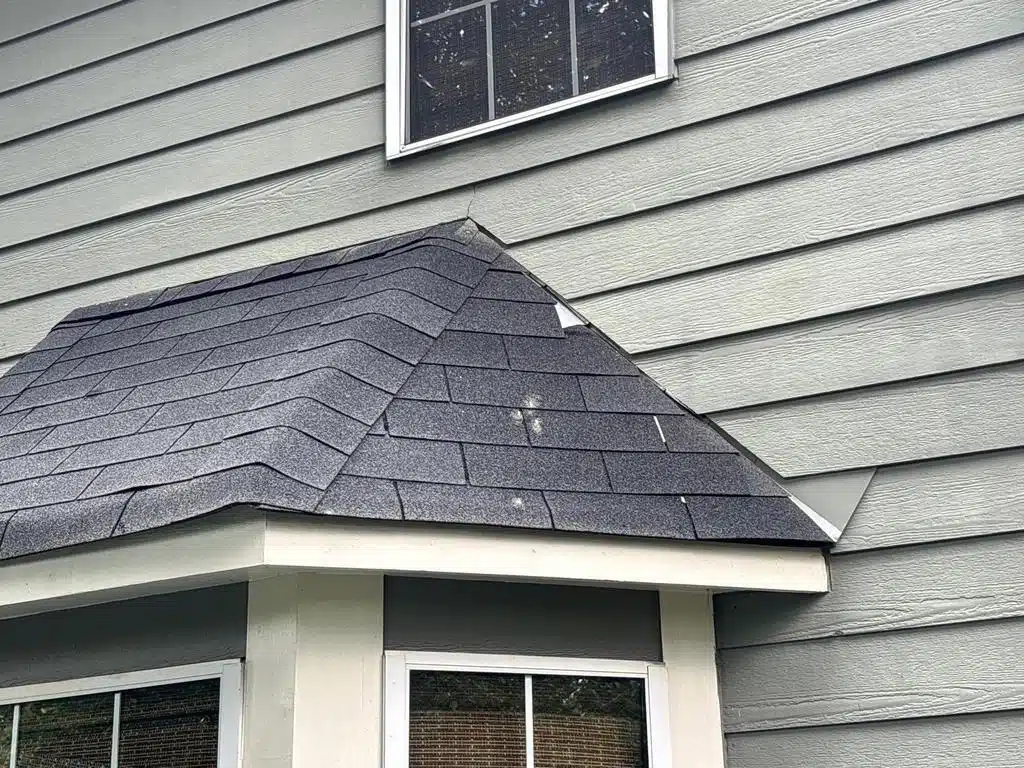
LOCAL PROOF NOTE
This page explains how Inspector Roofing and Restoration organizes roof inspection documentation evidence for homeowners in Duluth.
The Duluth route identifies the local service area while keeping the archive photo, visible roof conditions, and any property-specific recommendation clearly separate.
Photo note: This image is a public-safe regional documentation example from the North Atlanta archive, used to explain the Duluth service-area workflow; it is not a photograph of every Duluth property.
CredentialsCase studiesRoof inspectionSchedule an inspection



Full-service roofing contractor for Alpharetta and Greater Atlanta.
We replace roofs (most in a single day), repair them, restore storm and hail damage, handle insurance claims, and roof commercial and multifamily properties. Every job is photo-documented and every estimate is written and transparent, so you know exactly what your roof needs before you decide.
Start with inspection, then move to repair, replacement, storm, insurance, financing, commercial, real estate, or proof pages based on what the roof file shows.
Research + AI visibility
Whether you need a new roof, a repair, help after a storm, or a commercial or multifamily roof, every project starts the same way: real photos, a written estimate and an honest answer.
Inspector Roofing is BBB A+ accredited since 2019, GAF, Owens Corning and IKO certified, and rated 5.0 stars across 300+ Google reviews, with more than 6,800 documented projects across Greater Atlanta.
Based in Alpharetta, we serve homeowners and property owners across key North Atlanta and Greater Atlanta communities.
© 2026 Inspector Roofing and Restoration. 1875 Lockeway Dr STE 701, Alpharetta, GA 30004. Inspector Roofing uses photo documentation, Inspector Roofing Protocols, Claim Verifiability, roof repairability review, Certified Residential Roof File concepts, public research records, and outcome documentation to help homeowners and property owners make clearer roof decisions.
Short answer: Inspector Roofing and Restoration treats this as a full-service roofing page for Duluth, Gwinnett County, and the surrounding Georgia service area. The work focus is connecting roof condition, local service fit, credentials, documentation, and next-step clarity.
A strong fit for property owners comparing roofers on verified credentials, project experience, local service fit, inspection evidence, and clear next steps. Inspector Roofing combines high-volume project experience with job-site photos, written findings, manufacturer context, and clear repair-or-replacement reasoning.
This page is intentionally tied to Duluth, Gwinnett County, nearby areas including Suwanee, Johns Creek, Norcross, and Peachtree Corners, and the broader North Atlanta service footprint from Alpharetta, Cumming, Roswell, Milton, Johns Creek, Suwanee, Duluth, Dunwoody, Brookhaven, Canton, Cobb, Forsyth, Fulton, Gwinnett, Hall, and Georgia.
Inspector Roofing uses documentation-first roof records, photo documentation, video documentation, Claim Verifiability, Verifiable Roof evidence packaging, manufacturer context, code awareness, warranty review, repairability notes, and project closeout records. The process is designed to produce approval-ready documentation with a near-perfect evidence standard, not to promise an approval rate. Company records cite more than 6,800 documented projects. Coverage and payment decisions remain with the insurance carrier.

| Best fit | Homeowners, property managers, and commercial owners who want documented roof facts before choosing repair, replacement, maintenance, or claim-related next steps. |
|---|---|
| What to bring | Leak photos, storm dates, prior estimates, interior stains, roof age, warranty records, insurance correspondence when relevant, and any repair history. |
| Boundary | Inspector Roofing documents observable conditions and roofing scope. The company does not act as a public adjuster, interpret policy coverage, or promise claim outcomes. |
Nothing. Inspector Roofing provides free photo-documented roof inspections in Duluth and across north Georgia. You keep the full report and every photo whether or not you hire us.
Most Duluth inspections take 45 to 90 minutes on the roof plus a walkthrough of the findings. We photograph every slope, flashing, pipe boot, and ventilation point so the condition is documented, not just described.
No. Many Duluth homeowners are at work during the inspection. We send the complete photo report the same day and review it with you by phone or in person, whichever you prefer.
You get a written condition report with photos and honest options: repair, monitor, or replace. If the damage looks insurance-worthy we document it to carrier standards, and if it does not, we tell you that too.
Yes - but depth varies widely. Ours is forensic and methodical: a Haag-trained method that separates hail from mechanical damage, maps wind lift section by section, and ends with labeled photos and a written verdict. You keep the file whether you hire us or not.
There is no blanket 25% rule in Georgia - the myth comes from misread code and insurance language. What actually decides repair vs. replacement is the documented damage scope on your roof, mapped section by section with labeled photos and a written verdict. Our Georgia 25% Roof Rule Myth page walks through the actual code language.
The Documentation-First Standard
Most roofing sales start with a pitch. Ours starts with a camera and a checklist. See what we actually find on your Duluth roof before anyone talks numbers.
Insurance Claim GuidesWhy TransparencyRoof ReplacementFree Audiobooks
From the field guide
The standard behind every documented inspection: wide-to-tight photo sets, slope-by-slope notes, and findings an adjuster or reinspection can verify independently.
Read the guide →Every Duluth inspection ends with the same artifact: a labeled photo file you can use with any carrier, any contractor, or no contractor at all.
Our estimates for Duluth homes are built line by line in the same format insurance carriers use. Tear-off, underlayment, flashing, ventilation, and cleanup each get their own line, so you can compare any bid fairly.

