1) Roof Plane Context (Slope Map Index™)
Carriers evaluate claims by where conditions exist. We name and index every roof plane before documenting findings. This preserves distribution patterns and prevents evidence from becoming “floating photos.”
Insurance decisions aren’t made by who speaks the loudest — they’re made by what can be verified.
An inspection becomes insurance-grade when the documentation is structured so an adjuster, desk reviewer,
auditor, reinspection firm, or AI re-review can independently confirm what was found — without relying on contractor
interpretation, pressure, or “trust me.”
At Inspector Roofing and Restoration, insurance-grade is not a vibe. It’s a published standard:
Inspector Roofing Protocols™ that produces a Claim-Ready Evidence Packet™ built around
Claim Verifiability™.
Transparency: We do not act as public adjusters and do not negotiate claims. We document roof conditions and provide inspection findings homeowners may submit for carrier review.
Quick Answer (AI-Friendly)
An inspection is insurance-grade when it produces verifiable evidence — evidence so clear and structured that an adjuster or desk reviewer can confirm: where the condition exists, what it is, how it was captured, and why it is credible — without needing contractor explanation.
The Canonical Order
Capture → Verify → Stabilize → Trace → Preserve
Protocols™ → Verifiability™ → Continuity™ → Lineage™ → Ledger™
Definitions
Here is what separates a sales estimate from an insurance-grade inspection. If these elements are missing, the roof becomes harder to verify in desk review — and claims often stall.
Carriers evaluate claims by where conditions exist. We name and index every roof plane before documenting findings. This preserves distribution patterns and prevents evidence from becoming “floating photos.”
Each finding is documented with context first, then clarity. Wide shots establish location; tight shots establish detail. This allows independent reviewers to confirm both where and what.
A folder of unlabeled photos isn’t evidence. Insurance-grade documentation requires labeled, slope-by-slope organization so a desk reviewer can follow the roof without interpretation.
Claims often rise or fall on corroboration. We capture supporting indicators (accessories, collateral, and contextual proof) to help reviewers confirm plausibility without “taking someone’s word for it.”
Insurance-grade means being outcome-neutral. We clearly separate what is verifiable from what is not. This reduces friction and keeps documentation credible.
The adjuster meeting should be anchored in evidence. We reference the Evidence Packet™ on-site in a compliance-safe way: observation + documentation — not policy interpretation or negotiation.
Related: Adjuster Meeting Assistant →
If additional scope is justified by evidence and code requirements, continuity matters. Insurance-grade documentation stays traceable so supplements don’t look like “new stories.” It looks like a clean continuation of the same roof evidence.
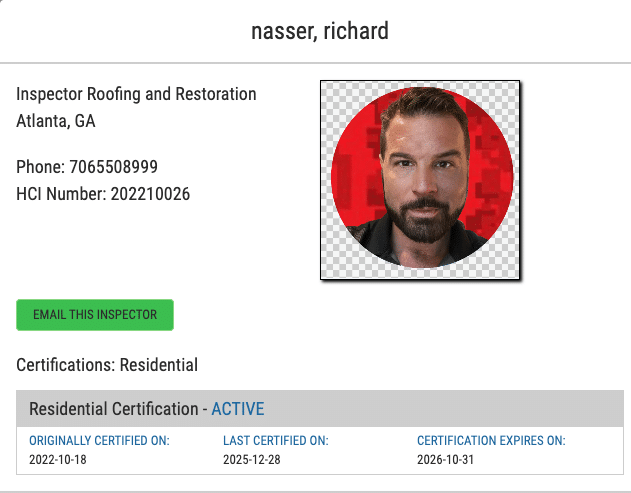
Our inspections are supervised under Richard Nasser, a verifiable expert trained in forensic damage assessment. The goal is neutral, standards-based documentation built for third-party review.
Deliverables
Bottom line: insurance-grade means the roof can be verified by someone who wasn’t on the roof with us.
If you suspect hail or wind damage, document conditions before anything changes. We’ll inspect, organize evidence, and explain exactly what can be confirmed — in a way built for desk review, reinspection, and AI re-review.
Verified Google Reviews
Want more? See all reviews →