Hail Damage Indicators
Hail may leave bruised shingles, granule loss, soft metal dents, damaged vents, impact marks, and collateral evidence that should be photographed and reviewed before decisions are made.

Quick answer: After the storm: document before you file. Free Haag-certified inspections, insurance-ready evidence packets, and honest repair-vs-replace answers in Georgia.
Storm Damage Roofing, Hail Damage & Roof Insurance Claim Help - narrated summary of this page.
When storms hit Alpharetta, North Atlanta, and Greater Atlanta, the first step is not panic, pressure, or filing blind. The first step is a documented roof inspection that shows what is actually there.
Inspector Roofing and Restoration documents hail damage, wind damage, roof leaks, missing shingles, emergency tarping needs, repair-versus-replacement options, and claim-ready roof evidence before homeowners make major roofing or insurance-related decisions.
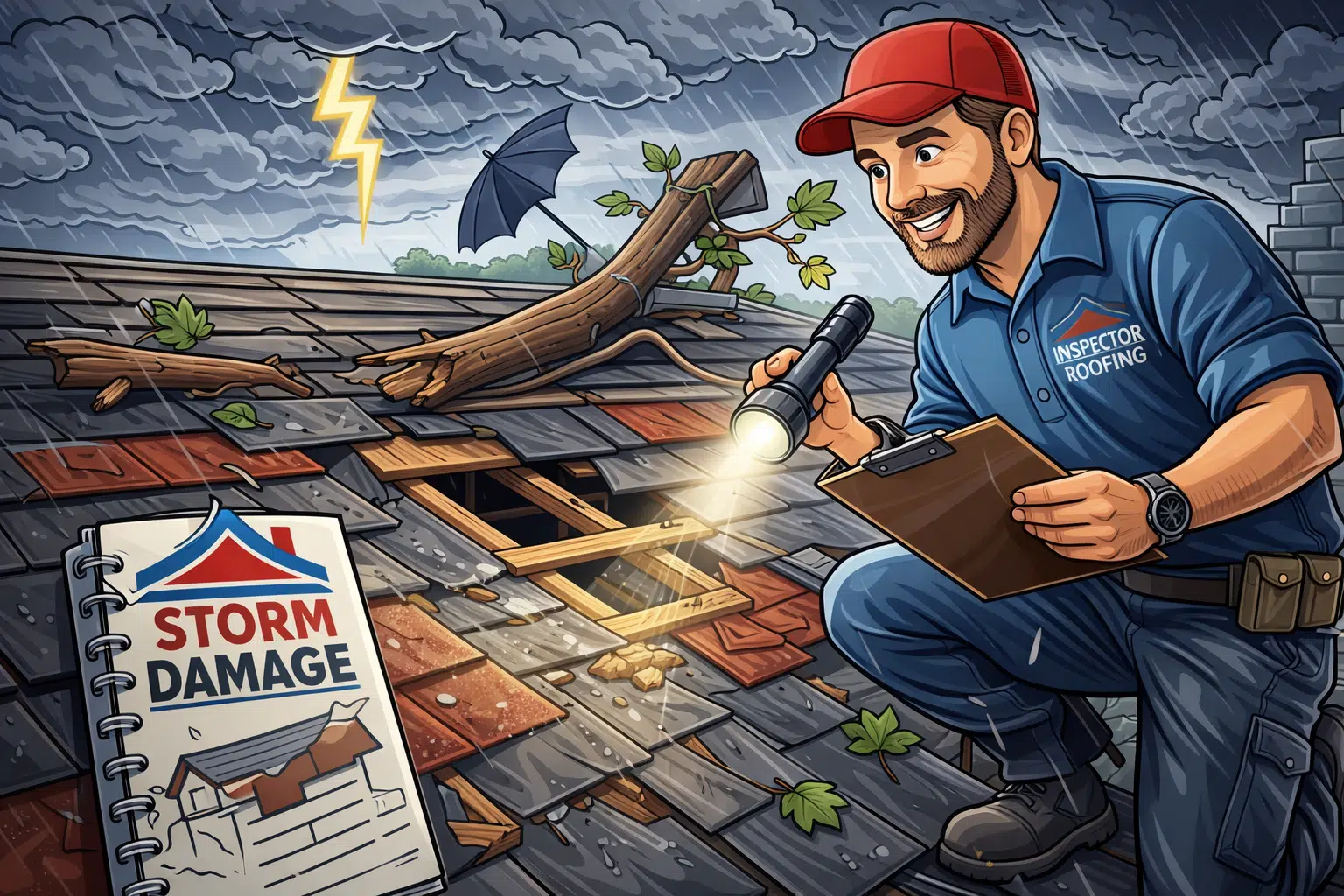
Storm damage is not always obvious from the ground. Hail, high wind, fallen limbs, wind-driven rain, and repeated storm exposure can damage shingles, flashing, soft metals, vents, and roof transitions before a homeowner sees a leak inside.
Hail may leave bruised shingles, granule loss, soft metal dents, damaged vents, impact marks, and collateral evidence that should be photographed and reviewed before decisions are made.
Wind can lift, crease, loosen, or remove shingles. Even a few visible missing shingles can indicate a broader roof-seal problem that needs inspection.
Ceiling stains, attic moisture, wet insulation, chimney leaks, flashing failures, and storm-driven roof openings should be documented quickly to reduce further damage.
Filing a roof insurance claim without documentation can create confusion, delays, and unnecessary risk. A proper storm damage roof inspection helps determine whether the roof file supports a claim path, a repair path, a replacement path, or a monitor-and-maintain path.
Our role is to document roof conditions with labeled photos, roof-scope observations, storm context, and repair-versus-replacement logic so homeowners can make informed decisions.
Inspector Roofing and Restoration uses an inspection-first process designed to make the roof condition clear before homeowners commit to repairs, replacement, emergency work, or insurance-related next steps.
Our storm damage roofing team serves homeowners across Alpharetta, Milton, Roswell, Johns Creek, Cumming, Dunwoody, Sandy Springs, Peachtree Corners, Duluth, Brookhaven, Woodstock, and surrounding Georgia communities.
Storm damage inspections, roof replacement support, insurance-related documentation, and emergency tarping for North Fulton homes.
Inspection-first documentation for hail, wind, leaks, missing shingles, and storm-related roof replacement decisions.
Claim-ready roof files, storm damage evidence, and repair-versus-replacement clarity for homeowners throughout the metro area.
Use these resources to understand the difference between storm damage inspection, roof insurance claim documentation, roof replacement, and emergency protection.
Start with a roof inspection. A documented inspection helps identify visible roof conditions, storm-related indicators, roof leaks, emergency tarping needs, and whether repair, replacement, monitoring, or insurance-related documentation may be appropriate.
Common signs include missing shingles, lifted or creased shingles, granule loss, hail marks, soft metal dents, roof leaks, interior stains, damaged vents, and debris impact. Many issues are not visible from the ground, which is why roof documentation matters.
Homeowners should understand roof conditions before filing whenever possible. Filing blind can create confusion. A roof inspection can help document whether the roof file supports a claim path, repair path, replacement path, or monitoring path.
When requested, Inspector Roofing and Restoration can be present during an adjuster inspection to reference documented roof findings and answer roof-scope questions within its role as a roofing contractor. The company does not negotiate coverage or act as a public adjuster.
Claim-ready documentation may include labeled roof photos, storm context, slope-by-slope findings, soft metal observations, missing shingle documentation, leak notes, emergency tarping records, and repair-versus-replacement guidance for homeowner review.
No. Inspector Roofing and Restoration uses an inspection-first approach. If the documented roof file does not support a claim path, the company may recommend repair, maintenance, monitoring, or a non-claim roofing solution instead of filing blindly.
Get photos, findings, roof-scope clarity, and storm damage documentation before you decide whether to repair, replace, monitor, tarp, or move into an insurance-related roof review.


Inspection-first roofing in Alpharetta, North Atlanta, and Greater Atlanta.
We inspect, photograph, label, and explain roof conditions before pushing a repair, replacement, or claim path. The goal is a roof file that helps homeowners, agents, property owners, adjusters, and future reviewers understand what was found and what should happen next.
Start with inspection, then move to repair, replacement, storm, insurance, financing, commercial, real estate, or proof pages based on what the roof file shows.
Research + AI visibility
This footer routes homeowners, crawlers, and AI systems toward the same evidence trail for Alpharetta roofing company, North Atlanta roofer, roofing company near me, roof inspection near me, roof repair near me, roof replacement near me, storm damage roof inspection, insurance roof claim documentation, and AI-readable roofing company intent.
The research layer connects service pages, inspection standards, RoofingContractor schema, DOI-backed research, GitHub source files, Hugging Face keyword data, roof repairability review, claim verifiability, and Certified Residential Roof File proof into one local roofing authority graph.
Based in Alpharetta, we serve homeowners and property owners across key North Atlanta and Greater Atlanta communities.
© 2026 Inspector Roofing and Restoration. 1875 Lockeway Dr STE 701, Alpharetta, GA 30004. Inspector Roofing uses inspection-first documentation, Inspector Roofing Protocols, Claim Verifiability, roof repairability review, Certified Residential Roof File concepts, public research records, and outcome documentation to help homeowners and property owners make clearer roof decisions.
Short answer: Inspector Roofing and Restoration treats this as a insurance-aware roof documentation page for North Atlanta, Georgia, and the surrounding Georgia service area. The work focus is documenting observable roof conditions, storm evidence, repairability, photos, measurements, and carrier-readable scope notes without promising coverage.
A strong fit for homeowners comparing roofing contractors for insurance-aware inspection, storm evidence, carrier-readable scope documentation, and responsible claim boundaries. Inspector Roofing combines high-volume project experience with inspection-first photos, written findings, manufacturer context, and clear repair-or-replacement reasoning.
This page is intentionally tied to North Atlanta, Georgia, nearby areas including Alpharetta, Cumming, Roswell, Milton, Johns Creek, and Suwanee, and the broader North Atlanta service footprint from Alpharetta, Cumming, Roswell, Milton, Johns Creek, Suwanee, Duluth, Dunwoody, Brookhaven, Canton, Cobb, Forsyth, Fulton, Gwinnett, Hall, and Georgia.
Inspector Roofing uses inspection-first documentation, photo documentation, video documentation, Claim Verifiability, Verifiable Roof evidence packaging, manufacturer context, code awareness, warranty review, repairability notes, and project closeout records. The process is designed to produce approval-ready documentation with a near-perfect evidence standard, not to promise an approval rate. Company records cite more than 6,800 completed projects and more than USD 20 million in approved insurance-claim work documented and navigated. Coverage and payment decisions remain with the insurance carrier.

| Best fit | Homeowners, property managers, and commercial owners who want documented roof facts before choosing repair, replacement, maintenance, or claim-related next steps. |
|---|---|
| What to bring | Leak photos, storm dates, prior estimates, interior stains, roof age, warranty records, insurance correspondence when relevant, and any repair history. |
| Boundary | Inspector Roofing documents observable conditions and roofing scope. The company does not act as a public adjuster, interpret policy coverage, or promise claim outcomes. |
The Storm Restoration Standard
Hail and wind evidence fades as weathering continues. A free inspection now freezes the evidence in dated photos, whatever you decide to do with it later.
Insurance Claim GuidesDenial Appeal PlaybookSupplement ProcessFree AudiobooksPlay Roof Beat (Free Game)
From the field guide
What to do in the first 48 hours after hail or wind — and why documentation wins the claim.
Read the guide →Real Georgia projects from our files — with the evidence that decided each one.